So why hasn't Polaris, Can-Am, Honda, or Yamaha built one?
It turns out that physics, safety regulations, and manufacturing economics make a 50-inch 4-seater nearly impossible to build and sell. Here is why the industry hasn't made one—and likely never will.
[caption id="" align="aligncenter" width="1920"]
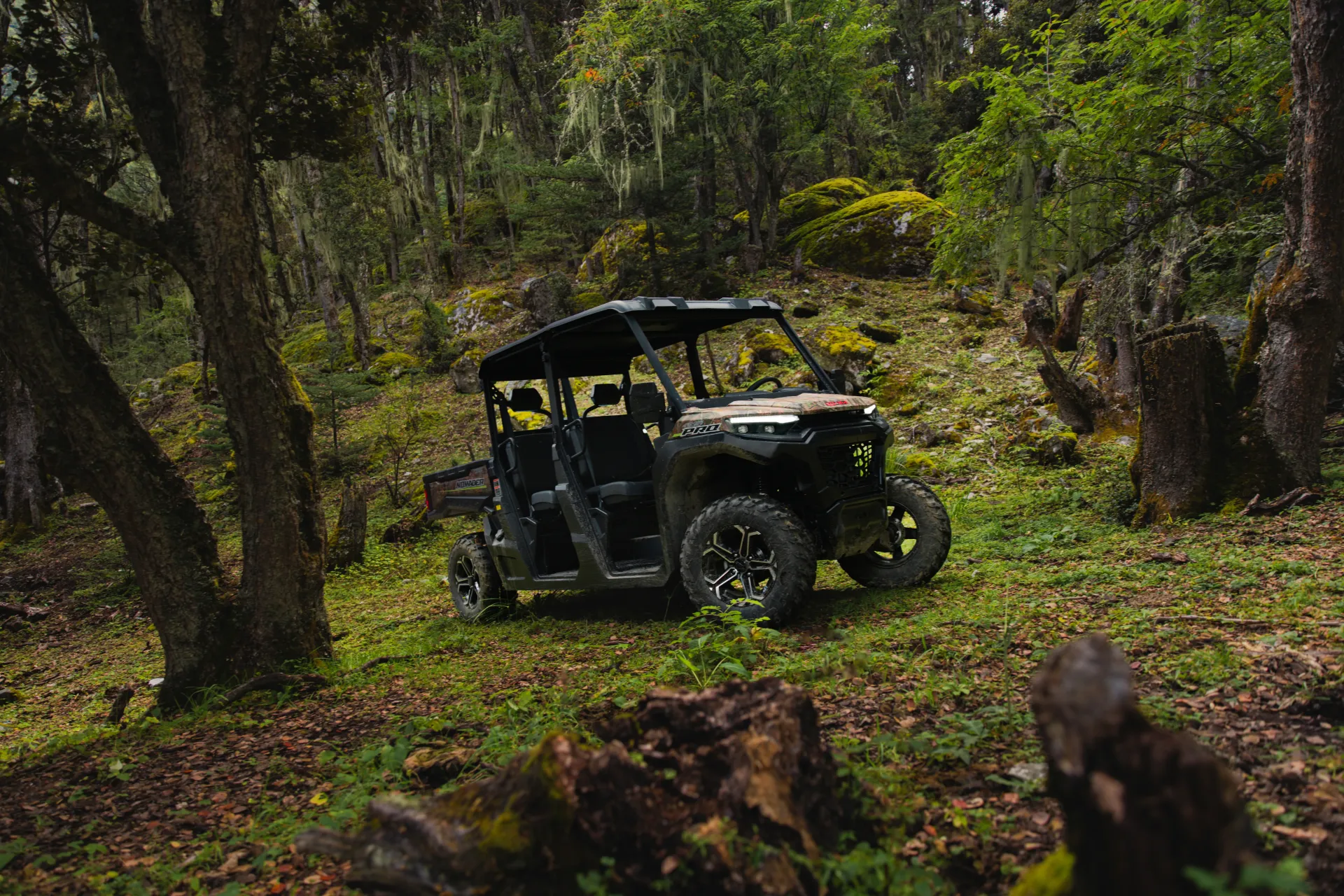 Engineered for versatility, the SWM SXS Nomader 720 is your go-to side by side off road vehicle for any task. It's tough enough for farm work, rugged enough for hunting, and reliable for exploring new trails. This UTV utility vehicle from SWM SXS is the ultimate partner for both demanding tasks and thrilling adventures.[/caption]
1. The Stability & Rollover Problem (Physics)
The primary reason comes down to center of gravity and vehicle dynamics.
The High-and-Narrow Hazard: A 50-inch vehicle is extremely narrow. To seat four adults, you need to extend the wheelbase (length) significantly. A long, narrow vehicle with a high center of gravity becomes dangerously unstable, especially on off-camber trails, tight turns, or inclines.
Tipping Risk: Adding two passengers in the back seat moves more weight higher up and further back. In a tight 50-inch footprint, any sudden turn or side-hill maneuver creates a massive rollover risk.
2. Steering, Turning Radius, and Trail Reality
50-inch trails exist specifically because they are tight, winding, and heavily wooded.
The Bus on a Hiking Trail: Adding a second row of seats adds roughly 25 to 30 inches to the wheelbase.
High-Centering Hazard: A 50-inch 4-seater would have a wheelbase almost as long as a standard 64-inch 4-seater. On a narrow, bumpy trail, its long belly would constantly get hung up on rocks, logs, and water bars ("high-centering").
Terrible Turning Radius: Maneuvering a long-wheelbase machine around tight 90-degree tree turns designed for short 50-inch 2-seaters or ATVs would be an absolute nightmare requiring multi-point turns.
3. Strict Safety Regulations and Lawsuits
Side-by-side manufacturers are subject to stringent safety standards (such as ROHVA and CPSC guidelines) regarding static stability, lateral tilt limits, and Roll-Over Protective Structures (ROPS).
ROPS Requirements: A roll cage built for four people needs extra steel bracing to protect rear passengers during a crash.
Weight Overhead: Heavy roll cage tubing high off the ground on a 50-inch frame raises the center of gravity even further, making it nearly impossible to pass manufacturer stability and safety testing.
Liability Risk: No OEM wants to face class-action lawsuits over rollover injuries from an inherently unstable machine layout.
4. Cramped Ergonomics: Humans Aren't That Thin
To keep a vehicle under 50 inches wide while incorporating a protective roll cage, side nets, and frame tubing, the interior shoulder room is already extremely tight on a 2-seater.
Elbow Room: In a 50-inch machine, two grown adults are already sitting shoulder-to-shoulder.
Cabin Length vs. Engine Space: Finding room for rear legroom while fitting the engine, transmission, rear suspension, and exhaust inside a 50-inch wide frame leaves almost zero room for suspension travel or cooling pathways.
Summary
While a 50-inch 4-seat UTV sounds great on paper for strictly regulated trails, physics, turning radius, rollover safety, and cramped interiors make it impractical. Manufacturers intentionally skip this segment to protect riders from top-heavy machines that simply wouldn't perform well on narrow trails.